
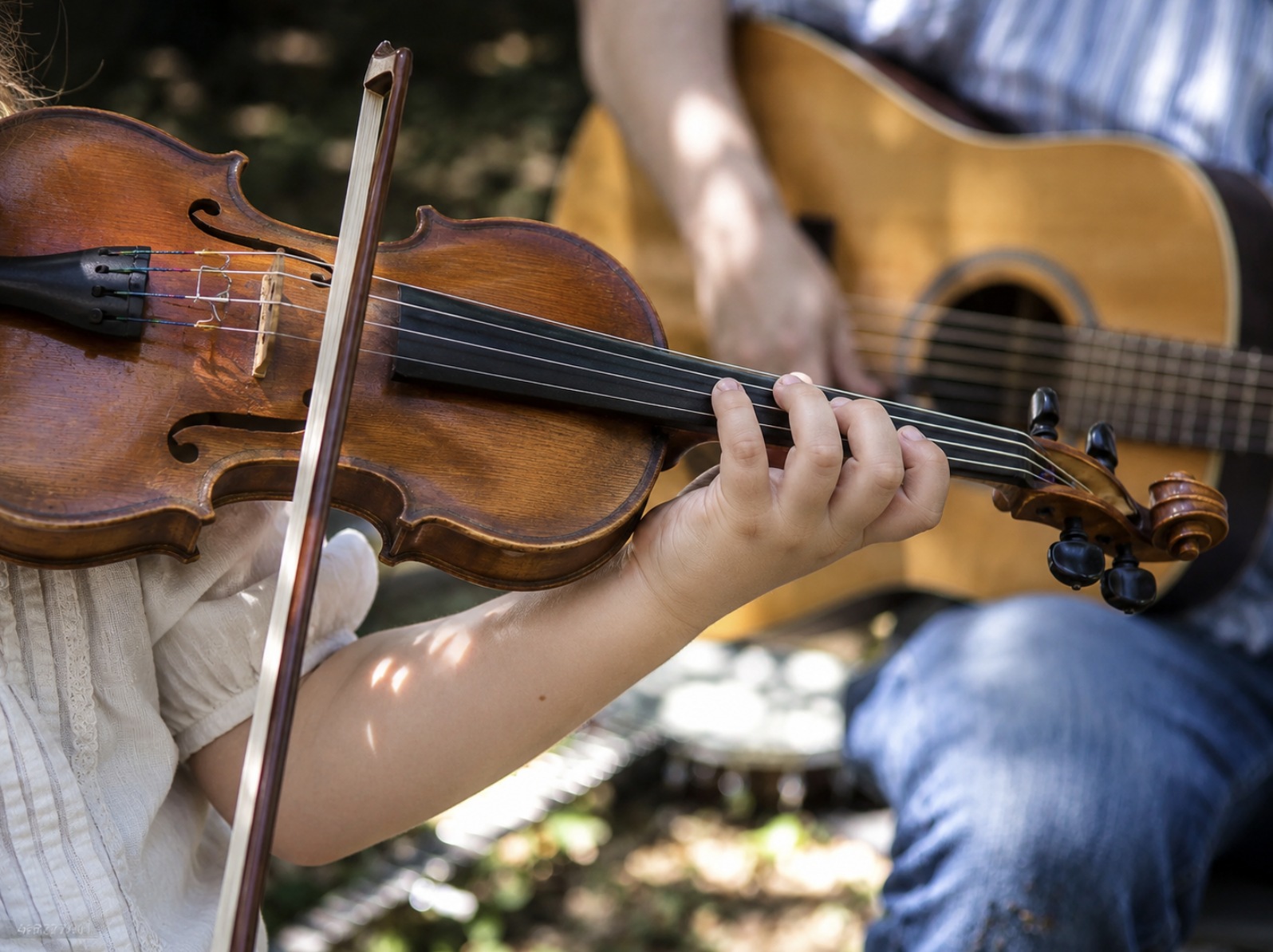
At Sacramento Community School, we envision music woven into the everyday life of our campus: children learning instruments, singing together, exploring musical traditions, and discovering the many ways music connects us to one another and the world around us.
There are wonderful social, emotional, and cultural reasons to make music a central part of school life. And increasingly, neuroscience is giving us even more reasons to pay attention.
What Happens in the Brain When We Make Music?
Learning to play an instrument is a remarkably complex task. The brain must coordinate hearing, movement, timing, attention, and memory, often while reading musical notation, listening to others, and adjusting in real time.
Researchers have found differences in brain regions involved in hearing, movement, and spatial processing when comparing musicians and nonmusicians. Studies following children over time also suggest that musical training can contribute to changes in the developing brain. This is an example of neuroplasticity, the brain's ability to adapt through experience and learning.
Some of the most interesting findings involve executive functioning, the mental processes that help us sustain attention, hold information in working memory, manage impulses, and adapt when circumstances change.
A 2025 meta-analysis of 46 studies involving 3,530 children found that musical training had a positive overall effect on executive functioning, with particularly promising findings for inhibitory control. Research also suggests potential benefits for working memory and cognitive flexibility, although results vary across studies.
Consider what happens when a group of children learns to play music together. They listen for cues, remember patterns, anticipate changes, coordinate their movements, and adjust to one another. They practice persistence, attention, and flexibility within an experience that can also be deeply enjoyable. The research is still developing, and musical training is no guarantee of broader cognitive gains. But it offers compelling evidence that making music engages important learning processes in ways worth understanding.
Music as Part of Everyday Learning
We imagine music finding its way into nearly every corner of the curriculum. Children might explore fractions through rhythm, investigate mathematical patterns in musical compositions, or study the physics of sound. Folk songs and protest music can open conversations about history, social movements, and cultural identity. Exploring traditional music offers a window into the lives and histories of different communities, revealing how music travels, evolves, and carries stories across generations. Poetry, language, and storytelling come alive through lyrics and song.
We'd like traditional music to have a real presence at the school. Rather than teaching these traditions only through formal lessons, we hope children will have regular opportunities to learn tunes by ear, play in sessions, and spend time making music with people who have been playing for years. Across so many cultures, music has been passed down much like stories, from one generation to the next. We'd love for our children to become part of that tradition, whether they're learning Appalachian fiddle tunes, Irish reels, French Canadian waltzes, Cajun two-steps, Cuban son, Balkan dances, or any number of musical traditions from around the world. We want children not only to encounter these traditions, but to learn them, play them with others, and eventually pass them along themselves.
Imagine a circle of musicians of different ages and abilities, some confidently carrying the melody while others are just beginning to find their way. Each brings different skills and experiences, with opportunities to learn from one another. Children learn by participating, taking risks, making mistakes, and gradually finding their own musical voice.
Perhaps learning the fiddle becomes an eight-year-old rite of passage, while students in the middle grades explore West African drumming with musicians rooted in those traditions. Some children may pursue their instruments with tremendous dedication, while others discover the simple pleasure of singing with friends or keeping a steady beat. And for some, music may become something even more significant.
Music and the Individual Learner
Music offers children different ways to participate, express ideas, and discover something about themselves. For some, it becomes a source of comfort, a way to work through emotions, or a means of expressing feelings that are difficult to put into words. For others, it sparks a passion that leads to hours of exploration, practice, and the deep satisfaction of developing a skill over time.
Music can also change how children see themselves. A child who struggles to find success in traditional academic settings may discover an extraordinary ear for melody, a natural sense of rhythm, or a gift for bringing people together through music. Another may find confidence in mastering a challenging piece or the courage to perform for an audience. These experiences can become powerful sources of competence, identity, and belonging.
This is part of what we mean when we talk about honoring the many ways children think, communicate, and make meaning. The arts invite forms of expression and participation that extend beyond spoken and written language. They give children opportunities to pursue their interests, develop their strengths, and be known and valued for abilities that might otherwise go unrecognized.
The Music That Makes a Community
There is something special about making music together. It asks us to listen, respond, cooperate, and find our place within a larger group. We imagine Friday sings, performances at community gatherings, and perhaps a choir that brings together students, families, teachers, and friends. Songs could help us welcome the school year, celebrate the changing seasons, or mark important moments in the life of our community.
Over time, these shared experiences become part of a school's identity. Children carry songs home. Families bring their own musical traditions into the community. Younger students learn from older ones, and music becomes something that belongs to everyone.
There is also something wonderfully democratic about making music together. You don't have to be the most accomplished musician in the room to participate meaningfully. There is room for beginners and experienced players, confident singers and those still finding their voices. Everyone has something to offer, and everyone has something to learn.
At Sacramento Community School, we believe the arts deserve a central place in children's education. The neuroscience offers fascinating insights into the relationship between music and learning. The connections to mathematics, language, history, and culture are rich with possibilities.
But music doesn't need to make children better at math or reading to justify its place in school. Making music is itself a meaningful human experience, one that invites creativity, expression, collaboration, and joy.
We want children to experience music as something they can create, share, and carry with them throughout their lives. And we want the songs, traditions, and experiences we build together to become part of what makes Sacramento Community School a community.
Perhaps years from now, a familiar melody will bring a former student right back to a Friday morning, surrounded by friends, singing together.
And isn't that a lovely thing for a school to give a child?
Further Reading
For those curious about the science of music and its role in learning, creativity, and community, here are a few articles and studies worth exploring.
Brain Structures Differ between Musicians and Non-Musicians
The Journal of Neuroscience, 2003
A foundational study examining differences in brain structure associated with musical expertise and experience.Boosting Executive Function in Children Aged 3–12 Through Musical Training
Frontiers in Psychology, 2025
A meta-analysis of 46 studies exploring how musical training may support children's attention, working memory, cognitive flexibility, and inhibitory control.How Playing an Instrument Affects Your Brain
BrainFacts.org, Society for Neuroscience, 2020
An accessible introduction to the neuroscience of musical training and the brain's capacity to adapt through experience.5 Ways to Better Use Music in Early Childhood Classrooms
Harvard Graduate School of Education, 2021
Practical ideas for using songs, musical traditions, and family participation to build inclusive, culturally responsive classroom communities.6 Smart Ways to Bring the Power of Music Into Your Classroom
Edutopia
Ideas for weaving music into everyday learning, from academic subjects to classroom routines and creative expression.
