
Visioning Our Grounds and Learning Spaces
This piece was written by Molly Chesbro, a founding parent at Sacramento Community School and a guest contributor to our ongoing visioning work and blog. Molly brings a rare blend of lived and professional experience to this conversation: she is a graduate of progressive education herself, having attended The Peninsula School, and she has worked at the intersection of architecture, design, and learning environments. Her work includes contributions to progressive school projects across the Bay Area, including The Nueva School, Marin Country Day School, and Lick-Wilmerding High School. We are grateful for her thoughtful lens as we imagine spaces that truly support children’s growth, curiosity, and belonging.
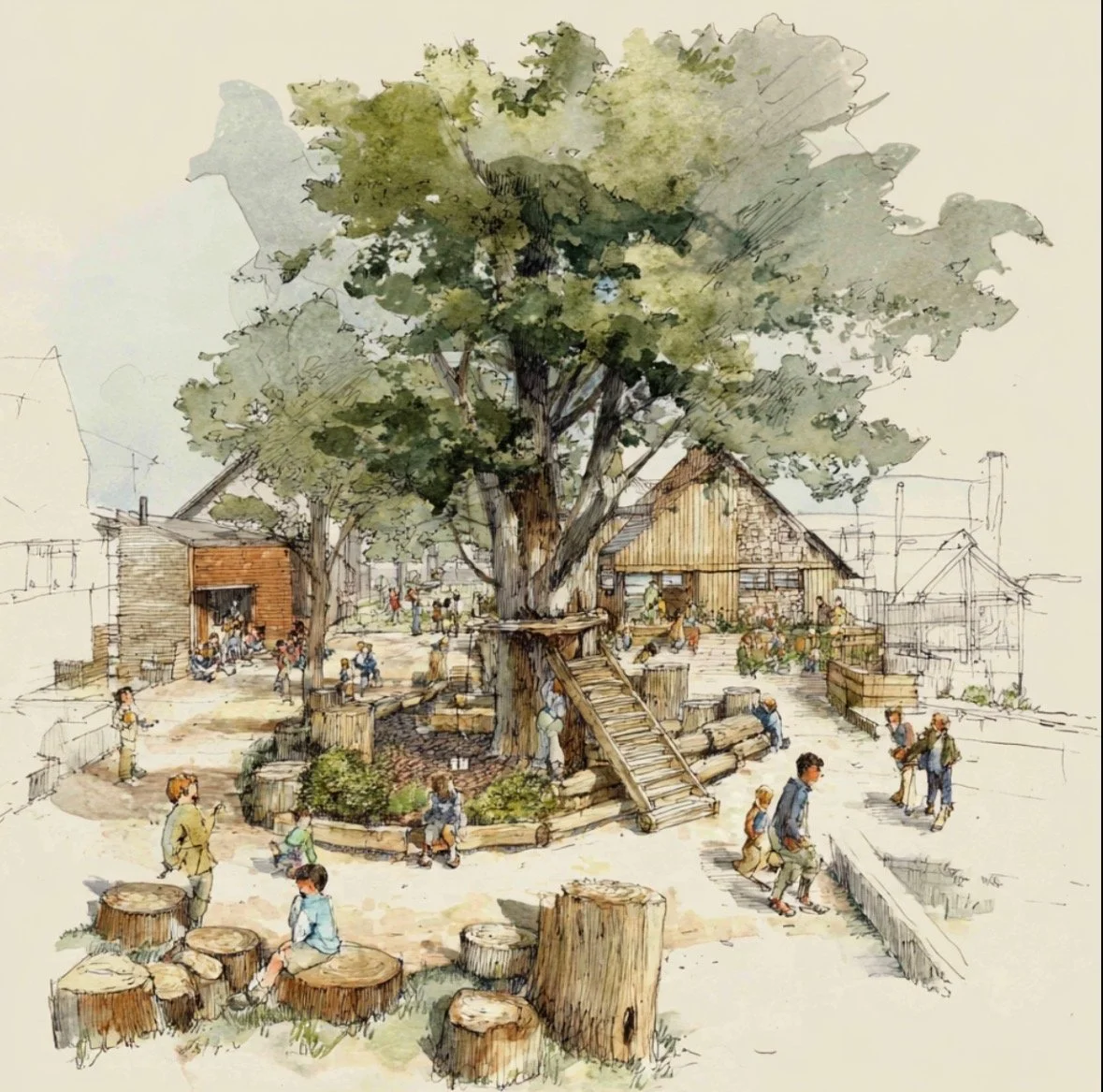
Visioning the grounds for our school is an exciting opportunity. As a collective, we have experienced many progressive school campuses, and we feel energized by the wide-ranging possibilities for our growing community of families. We’re equally excited to hear from families about the ideas they have for what a school’s grounds could be. The land is a canvas for learning and reflecting our shared values of curiosity, creativity, connection, and care. Like our academic program, these spaces will recognize that learning and human development are interconnected, and that children make sense of the world through experience, inquiry, and relationship.
Progressive education is rooted in the belief that children learn best through experience. Our grounds will embody this philosophy by weaving flexibility, materiality, and nature together in ways that invite meaningful, lasting engagement. These spaces will be designed to support learners at different developmental stages, encourage collaboration, and create opportunities for authentic connection with one another, with adults, and with the wider community.
As former children, now parents and educators, we feel deeply that children should be able to be children for as long as possible. We know that play matters at every stage of development, not just early childhood. We want our spaces to embrace this idea. One of our many inspirations for the grounds comes from the Reggio Emilia approach, where the environment is often described as “the third teacher.” The first teachers, parents and peers, are active partners in student learning. The second is the classroom teacher. The third teacher, the environment itself, communicates what is valued and plays a central role in making learning meaningful. In this way, the environment reinforces what we believe about learning itself: that it is active, not passive, and that growth comes through creating, experimentation, and collaboration.
We think of the learning environment as a flexible, vibrant space where teachers and students co-create and learn together. Indoor and outdoor learning spaces reflect the values we want to communicate to our students and can help shape a child’s sense of identity and belonging. It is the relationship between these three teachers - people, educators, and environment - that ignites deep learning. We envision a school space that supports this ethos, offering students a dynamic environment where they feel safe, loved, and welcomed.
Our outdoor spaces are designed as living classrooms, where nature itself becomes a primary learning material. Through the use of loose parts (sticks, stones, pinecones, water, dirt, leaves) students build, invent, negotiate, and imagine, creating everything from mud kitchens and nature sculptures to complex miniature worlds. Logs, stumps, and uneven terrain invite physical challenge and risk-taking, strengthening coordination, confidence, and resilience. Learning flows easily outdoors: lessons adapt as whiteboards, books, and tools move outside, blurring the line between play and inquiry. Research shows that regular access to nature reduces stress, supports mental health, increases engagement and problem-solving, and deepens curiosity, creativity, and social connection.
Our youngest learners will experience the grounds as places of magic and wonder; spaces that invite imagination, storytelling, and embodied play. Climbing-trees, sandboxes, and wide-open areas are not simply play zones; they are catalysts for movement, exploration, and joyful discovery. For older children, the environment shifts in scale and texture, offering cozy nooks, shaded corners, and gathering spaces for conversation, collaboration, and reflection. These flexible outdoor spaces support friendships, independence, and the social-emotional learning that allows students to engage more deeply with their work and one another. We invite children to ask real questions, test ideas, collaborate with peers, and engage with the world as it is, not as a worksheet version of it.
A simple outdoor stage might host imaginative play for younger students, then later transform into a theater for older learners performing poetry, skits, or historical reenactments as part of their humanities studies. The same space evolves alongside the children who use it.
Inside our classrooms, this same philosophy continues. Progressive classrooms are not static or desk-bound; they are flexible, responsive environments designed to meet the needs of the learners within them. We see classrooms as carefully curated spaces that invite inquiry, creation, collaboration and independence.
Our classrooms will feature movable furniture, open floor space, and a variety of work areas: tables for collaboration, quiet corners for reading or reflection, rugs for community gathering, and studio-style zones for making, building, and experimentation. Materials will be visible and accessible, encouraging students to make choices, follow their curiosity, and take ownership of their learning.
Natural light, thoughtful organization, and materials drawn from the natural world help create calm, grounded spaces that support regulation and focus. Walls will document student thinking; sketches, drafts, questions, and reflections, making learning visible and honoring process over product. Rather than classrooms that look the same year after year, these spaces will evolve alongside the students, shaped by their projects, interests, and identities.
Importantly, our indoor spaces are designed to support learners across ages and learning profiles. Flexible layouts allow teachers to adapt the environment for small-group work, whole-class collaboration, or independent exploration. These classrooms support movement, sensory needs, and varied ways of engaging with content, recognizing that children learn in many different ways.
In envisioning our school grounds and classrooms, we are not just designing physical spaces, we are shaping a landscape that reflects our values as a community. We are building an inclusive learning environment that supports the whole child and invites students to grow with purpose, confidence, and care for the world around them. A place rooted in belonging. These spaces will grow with our children and our families, reflecting who we are and what we believe learning should be: alive, relational, and deeply human.
